The Cold Open: What a Story Gains by Starting Before the Beginning
A cold open creates a question before the titles, giving viewers a reason to enter the main story and a clear detail to watch for.
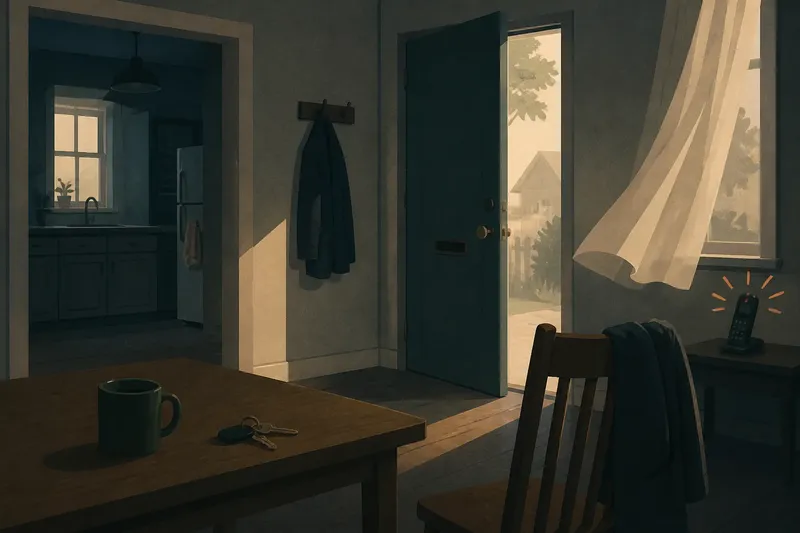
The first shot shows an empty kitchen, a chair rocking gently beside the table. Then a phone rings in a room where nobody seems to be. A cold open uses a moment like this to make a viewer ask what happened before the main titles appear. Its value lies not in mystery for its own sake, but in shaping how the audience enters the story that follows.
What question should the cold open plant?
Start by naming the question you want the viewer to carry into the main story. It might be “Who left the door open?”, “Why is this character hiding?” or “What has changed since we last saw this place?” Keep it narrow enough to hold in mind, but meaningful enough that the next scene can deepen it.
A useful cold-open question points towards the episode’s central pressure. A strange object can suggest a secret; an unexplained choice can suggest a conflict. If the opening raises a question that the rest of the story never touches, it will feel like a separate teaser rather than an entrance.
Write the question in plain language before drafting the scene. This is a private test, not dialogue to insert. If you cannot state what the viewer is wondering, the opening may be relying on atmosphere without giving that atmosphere a direction.
How much of the beginning should you show?
Choose the smallest slice of action that makes the question visible. A cold open does not need to explain who everyone is, where they are, or how they arrived. It needs enough concrete information for viewers to notice an interruption, a contradiction or a choice.
For instance, say you are writing a drama about a family meeting after a long silence. You could begin with one sibling placing a second cup at the table, though the other chairs are empty. The viewer can see the deliberate gesture and wonder whom it is for. The main titles can then lead into the family’s arrival, where that small detail takes on a sharper meaning.
Keep the scene legible. A face, a sound, an object or a clear action gives the audience something to hold. Withholding every identifying detail can make confusion look like suspense. The viewer should know what they have seen, even if they do not yet know what it means.
Where should the titles interrupt the action?
Place the title sequence after the opening has established its question, but before the answer drains its force. The interruption is part of the design: it gives the audience a moment to hold the image in mind, then returns them to a story that may explain, complicate or redirect it.
Try ending the opening on a change rather than an arbitrary cut. A character hears a familiar voice from an unexpected room. A light goes out while someone is still speaking. A person recognises an object and chooses not to touch it. Each gives the titles a clear point of departure.
Then consider what the first scene after the titles does. It can rewind to show how the opening became possible, move forward to reveal its consequence, or shift to another character whose actions will eventually connect. Whichever route you choose, make the relationship clear enough that viewers understand why the opening came first.
How does a cold open change the viewer’s entry?
A conventional opening often begins by orienting the audience: here is the setting, these are the people, and this is their ordinary situation. A cold open begins with a disturbance or a partial result. The viewer enters by asking a question, then gathers context while watching for a possible answer.
That shift can make familiar information feel purposeful. Instead of meeting a character in a neutral scene, we may first see them refuse to open a letter. When the story later shows the letter arriving, the ordinary event now carries tension. The audience has a reason to notice how the character behaves.
There is a trade-off. An opening that promises a puzzle can lead viewers to expect that the story will address it. If the episode is really about something unrelated, the initial question may feel like a false invitation. A quieter beginning may suit a story whose appeal depends on gradual observation rather than a forward pull.
What should you check before keeping it?
- State the question. Can you express what the viewer is likely to wonder in one clear sentence?
- Check the visible action. Is there a specific image, sound or choice that gives rise to that question?
- Find the story connection. Does the question touch the episode’s conflict, character or setting?
- Choose the interruption. Do the titles arrive after the question is clear and before the scene settles into explanation?
- Test the return. Does the first post-title scene deepen, reframe or deliberately postpone the opening’s question?
- Consider the promise. Will the story give viewers a meaningful response, even if it does not provide a tidy answer?
It is not worth adding an ominous sound, a cryptic line and a mysterious object if they all ask the same thing. One strong signal is usually easier to read than a pile of clues competing for attention.
When does a cold open work best?
A cold open is especially useful when the episode benefits from showing a consequence before its cause, or when a character’s behaviour becomes more revealing if we first see it out of context. It can also establish a tone quickly: comic awkwardness, unease or sudden urgency can all arrive before the titles.
It is less useful when the opening needs several paragraphs of explanation to become intelligible, or when the titles interrupt a scene whose main force depends on uninterrupted emotion. In those cases, beginning with the main story may give the audience a steadier, more honest entry.
What do viewers usually want to know about cold opens?
Does a cold open have to be mysterious?
No. It can be funny, startling, tender or simply unusual. The essential feature is that the scene begins before the usual title sequence and gives the viewer a reason to keep watching.
Should the opening be explained immediately?
Not necessarily. The next scene may answer the question, add context or make the opening harder to interpret. What matters is that the story keeps the question relevant rather than abandoning it.
Can a cold open introduce a character?
Yes, particularly if it shows a revealing decision or behaviour. A brief action can give viewers a sharper first impression than a list of background details.
How can you tell if the opening is too confusing?
Ask a reader to describe what they saw and what they wondered. If they cannot identify the event or the question, add a clear point of reference rather than explaining the whole situation.
The cold open works when its first question changes the way the next scene is watched. Keep that question tied to the story, and the titles become more than a pause: they mark the passage from a striking fragment into the fuller sequence of causes and choices. That is the practical test for a cold open—the audience should return from the titles looking at the story with one specific thing in mind.